How Long Do Backlinks Take to Work? The Five-Stage Timeline
backlink usually takes six to twelve weeks to produce a measurable ranking effect. Under unfavourable conditions it takes longer than six months, or it never works at all. The reason is structural: a link passes through five separate stages before it influences anything , and publication completes only the first. A
Backlinks rarely improve Google rankings immediately. In most cases, a quality backlink takes approximately six to twelve weeks to produce a measurable SEO result. Under less favourable conditions, the process may take several months—or the link may have no meaningful impact at all.
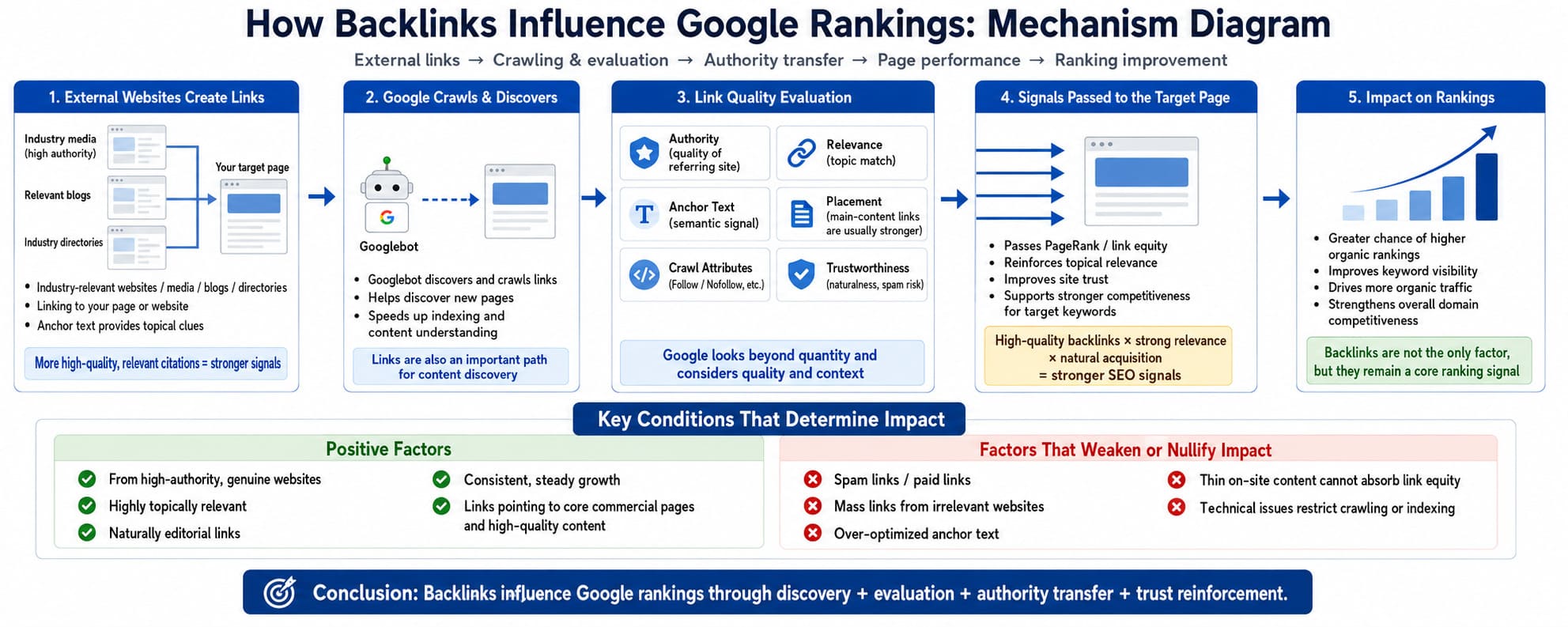
This delay occurs because every backlink must pass through several stages before it can influence search rankings.
The Backlink Timeline
First, the backlink must be published on a publicly accessible page. The page should not be blocked by robots.txt, marked with a noindex directive, or hidden behind a login.
Google must then recrawl the page and discover the new link. Frequently updated authority websites may be crawled within hours or days, while smaller or inactive websites may take several weeks.
After discovery, Google decides whether to index the linking page. A crawled page is not automatically indexed. Thin, duplicated, or low-quality content may never enter Google’s index, meaning the backlink cannot contribute to rankings.
Google must then process the link and incorporate it into its link graph. Backlinks commonly appear in Google Search Console several weeks after indexing, although the report is sampled and delayed.
Finally, the target page may begin to show changes in rankings, impressions, or organic traffic. This normally becomes visible within four to twelve weeks.
What Determines How Quickly a Backlink Works?
Several factors affect the timeline:
The crawl frequency and authority of the linking website
Whether the link appears naturally within the main content
The relevance between the linking page, anchor text, and target page
The quality and competitiveness of the target page
The difficulty of the target keywords
The existing authority of the receiving website
One backlink rarely creates a significant ranking change on its own. Several relevant links pointing to the same priority page are generally more effective than spreading the same number of links across many different pages.
Why Do Many Backlinks Send No Referral Traffic?
Many commercial link placements receive little or no traffic because the publishing websites have few genuine readers. High Domain Rating or Domain Authority scores do not guarantee that an individual page receives organic visits.
Referral traffic may also be underreported because of privacy restrictions, browser policies, and incorrect attribution. UTM tracking should therefore be used whenever referral traffic and conversions are important campaign objectives.
What Should Businesses Measure?
Instead of focusing only on total backlink volume, businesses should evaluate:
Referring domain quality and relevance
Organic traffic to the linking page
Contextual placement of the link
Ranking and impression changes for the target page
UTM-tagged referral conversions
Brand mentions and citation visibility in AI-generated answers
The key conclusion is simple: backlinks should be evaluated over months rather than days. Quality, relevance, concentration, and the strength of the target page matter far more than the total number of links acquired.